Research
Georgia Institute of Technology: Intuitive Machines’ Lunar Constellation
This is my present (Summer 2023 to now) research! I work with Intuitive Machines as a position, navigation, and timing (PNT) analyst, aiding their work on a NASA contract to provide a 5-satellite lunar constellation of navigation and communications satellites. I started helping them shortly after they submitted their proposal, and served as effectively the sole PNT analyst until they were awarded the contract in Fall 2024. Now the team is huge, and as we work to launch the first satellite in Fall 2026, the work gets ever more detailed. I believe NASA was initially trying to build this constellation themselves (hence me working on LCRNS details in Summer 2022) but for whatever reason they decided to contract it out instead; so now I’m working on LCRNS again! In no particular order, the analysis tasks I’ve done include:
- development of a time-correlated and state-dependent measurement error budget for these lunar navigation systems
- lunar user (rover, satellite, lander) navigation simulations using these constellations
- constellation optimization against NASA coverage requirements
- GPS time transfer simulations for lunar orbits
- advanced clock modeling efforts to try to maintain an accurate time standard (Lunar Coordinated Time anyone?)
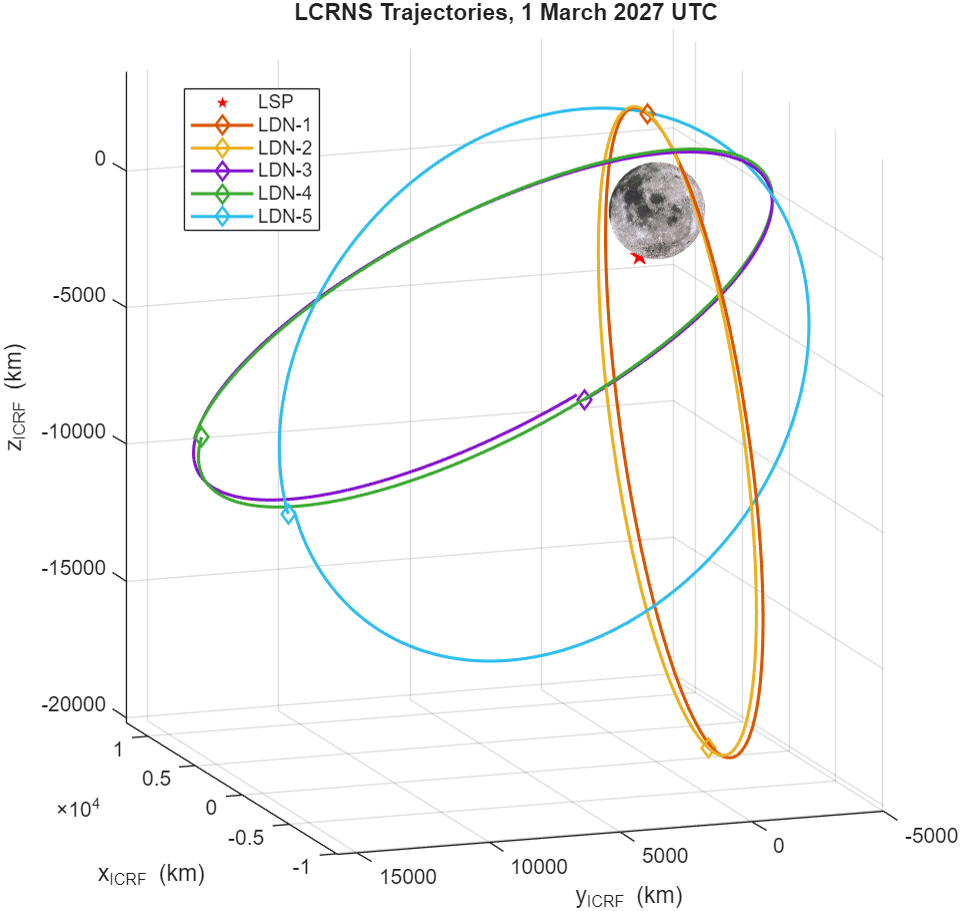
Plot of LCRNS trajectories over 1 orbital period (32.8 hours)
Journal Publications:
- Hartigan, M., & Lightsey, E. G. (2025). Adaptation of One-Way Radiometric Range and Range-Rate Errors to the Lunar Environment. NAVIGATION: Journal of the Institute of Navigation, 72(3), navi.714. https://doi.org/10.33012/navi.714
Conference Papers:
- Hartigan, M., Garcia, F., Lightsey, E. G., & Stewart, S. (2025). Navigation Filter Design for an LCRNS Receiver during Lunar Powered Descent and Landing. 2947–2962. https://doi.org/10.33012/2025.20260
- Mina, T., Thrasher, A., Hartigan, M., Leonard, J., Stewart, S., Antreasian, P., Pipich, K., Brack, D., Gaylor, D., Bedford-Dillow, B., Lightsey, E. G., & Christian, J. (2025). Preliminary Navigation System Design for the First LCRNS Satellite Providing Lunar PNT Services. 2909–2946. https://doi.org/10.33012/2025.20351
- Brack, D., Roorda, T., Mathur, R., Stewart, S., Hartigan, M., Crenshaw, J., Volle, M., & Ryden, G. (2025, August 12). Preliminary Design of the Lunar Data Network Constellation Under Operational Considerations. 2025 AAS/AIAA Astrodynamics Specialist Conference. https://ntrs.nasa.gov/citations/20250006883
- Hartigan, M., & Lightsey, E. G. (2024, August). Derivation and Simulation of User Scenarios for Lunar Navigation Satellite Systems. 2024 AAS/AIAA Astrodynamics Specialist Conference. LINK TO PAPER
Poster Presentation:
- Hartigan, M., & Lightsey, E. G. (2025, May). Measurement and Navigation Performance for Users of a LunaNet-Compliant Constellation [Poster]. Lunar Surface Innovation Consortium Spring Meeting, Laurel, MD. LINK TO POSTER
- Hartigan, M., & Lightsey, E. G. (2024, May). Modeling Timing Uncertainty in Cislunar Space using GPS Time Transfer [Poster]. Lunar Surface Innovation Consortium Spring Meeting, Laurel, MD. LINK TO POSTER
Georgia Institute of Technology: Space Sustainability
This work was actually a wonderful opportunity that I got after finishing up Dr. Thomas González Roberts’ class on space sustainability! My final project group (Neel, Polina, Theo, Christian, and myself) decided we liked our work well enough to submit it to a conference. The class was wonderful; it centers around the factors that shape sustainable decision-making in outer space, looking at behaviors through the lens of evidence based policy analysis. We used open-access tools like space-track.org to analyze compliance with federal rules and international policy agreements as they pertain to space sustainability practices. Our paper, linked below, explores the implications of a really interesting Nature article that shows rising greenhouse gas emissions will slow orbital decay of satellites (the primary way we keep low Earth orbit clean). In our work, we extend this by combining various emission projection models, called Shared Socioeconomic Pathways, with analogous space congestion models, called Space Environment Pathways. In the end, we illustrate that accounting for climate futures is necessary when attempting to project future space populations, as it can result in a 15-100% increase in space population by the end of the century.
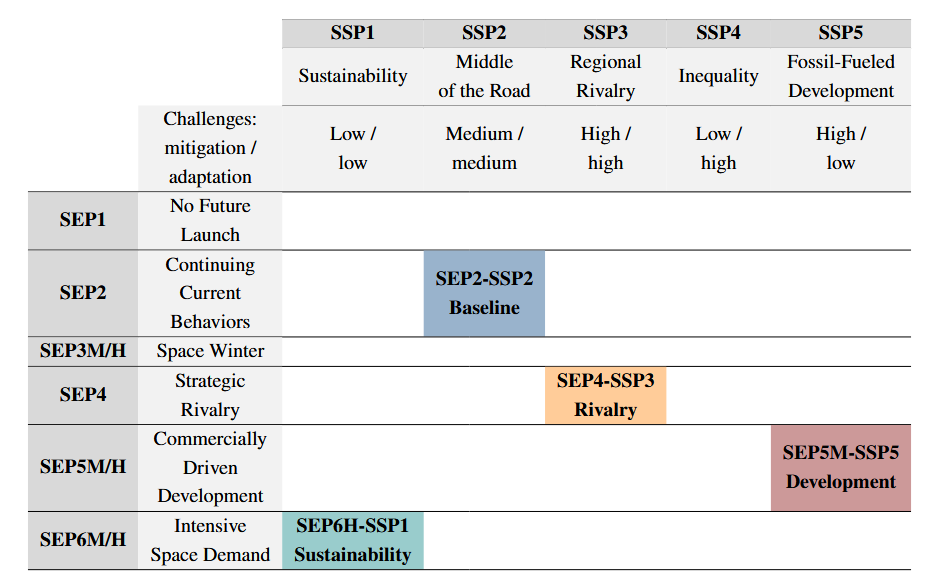
Matrix across SSP and SEP combinations, with the four cases analyzed in our paper highlighted
Conference Paper:
- Puri, N., Verkhovodova, P. A., Hartigan, M., St. Francis, T., Roberts, T. G., & Brownhall, I. (2026, January 12). Space Sustainability Implications of Combining Space Environment Pathways With Shared Socioeconomic Pathways. AIAA SCITECH 2026 Forum. https://doi.org/10.2514/6.2026-0159
Georgia Institute of Technology: Cislunar PNT IRAD
This was a multiyear (Spring 2022 to Spring 2024) internal research and development (IRAD) project with the Georgia Tech Research Institute and a couple other research labs on campus, conducting a study on providing a navigation, timing, and communications service in cislunar space. This is the project where I really cut my teeth on research that eventually became my PhD topic. I conducted broad literature reviews, used GPS/GNSS as an analogue to develop metrics for evaluating candidate navigation systems, created my first navigation simulations for users, and used GMAT for constellation design. This is also when I came to hate GMAT’s MATLAB API and decided to just make my own orbital propagator. After my PhD is over I’ll probably make a blog post about all the effort that went into tooling for my research (and how it’s all basically wasted cuz it’s in MATLAB which is a cursed and super expensive proprietary language).
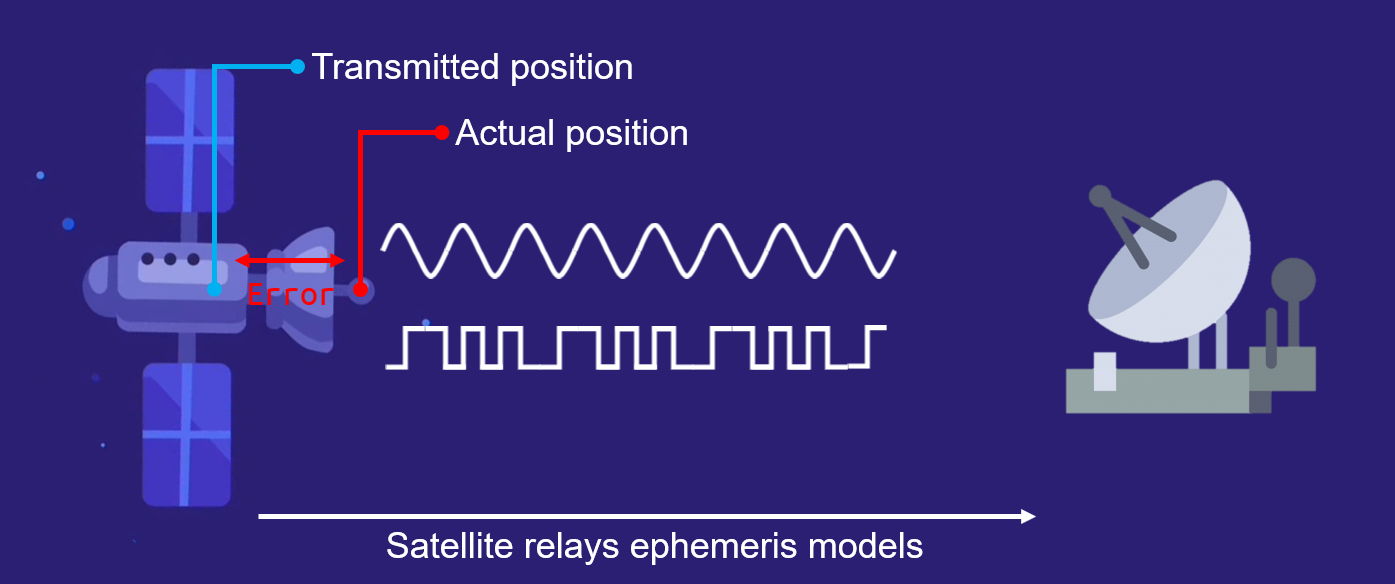
Illustration of broadcast ephemeris error in GNSS-like systems
Conference Papers:
- Hartigan, M., Smith, D., & Lightsey, E. G. (2023, August). Optimization of Early-Phase Cislunar Navigation Constellations for Users Near the Lunar South Pole. 2023 AAS/AIAA Astrodynamics Specialist Conference. LINK TO PAPER
- Hartigan, M. (2023). Simulation and Analysis of Navigation Performance for Cislunar PNT Constellations [Master’s Project, Georgia Institute of Technology]. https://hdl.handle.net/1853/73398
Poster Presentation:
- Hartigan, M., Smith, D., & Lightsey, E. G. (2023, May). Planning and Initial Performance of a Cislunar Position, Navigation, and Timing Service [Poster]. Lunar Surface Innovation Consortium Spring Meeting, Laurel, MD. LINK TO POSTER
NASA Goddard: Lunar Relay Maneuver Planning
Whoa I worked for NASA (Summer 2022)! Sadly all the interns were still entirely remote due to lingering COVID restrictions, so I worked from my studio in Atlanta. Had to go to Huntsville to get a badge though. I worked with Noble Hatten and Sun Hur-Diaz to develop a recommendation for momentum desaturation of some proposed lunar navigation network satellites called LCRNS – and pronounced elk-horns. They would make an appearance again later in my PhD…
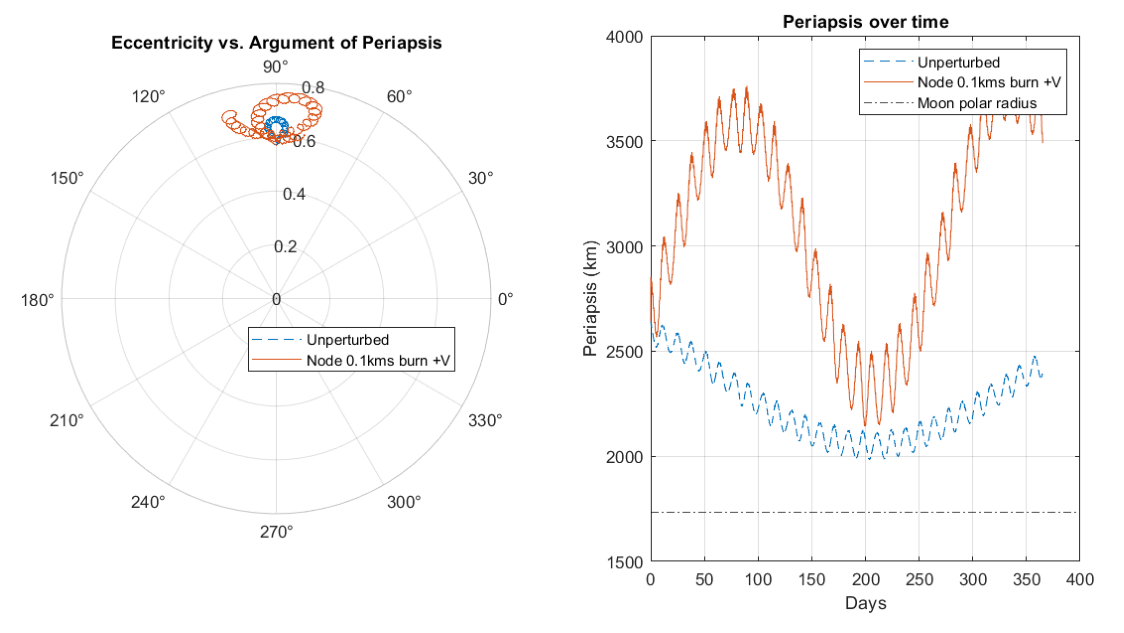
Plots illustrating how lunar frozen orbits are disturbed by maneuvers
Conference Paper:
- Hartigan, M., Hatten, N., & Hur-Diaz, S. (2023, February). Momentum Unload Maneuver Planning for a Lunar Navigation Satellite. Proceedings of the 45th Annual American Astronautical Society Guidance, Navigation, and Control Conference. AAS/AIAA 45th Annual Guidance, Navigation, and Control Conference. LINK TO PAPER
Georgia Institute of Technology: Design and Assembly of 3D-Printed Cold Gas Propulsion Systems
In the first year of my PhD at Georgia Tech (Fall 2021 through Spring 2022), I started work in median res on the delivery several different cold gas propulsion systems for three CubeSat missions: SunRISE, VISORS, and SWARM-EX. Each mission was in a slightly different stage of development and had differing levels of programmatic oversight, but ultimately I was engaged with finalizing designs for manufacturing, procurement, assembly, and testing. I used Solidworks CFD simulations to optimize for maximum delivered impulse and minimum dry mass while maintaining an appropriate safety factor for a pressure vessel. We worked with suppliers and machine shops to 3D print the conformal tank geometry, get components machined from drawings, and acquire off-the-shelf components when available. I drafted iterations of assembly and test procedures for each, and worked with teammates to assemble engineering and flight units in our clean room in the Engineering, Science, and Mechanics building on campus. I worked with other grad students on the initial stages of testing, such as thermal vacuum, propellant fill and drain, and measuring thrust using a counterbalanced stand. For SunRISE, we performed qualification and acceptance testing with Utah State University and JPL engineers to NASA standards. Ultimately though, my research interested lay elsewhere, so I transitioned to different work before all the testing was completed and units were delivered.
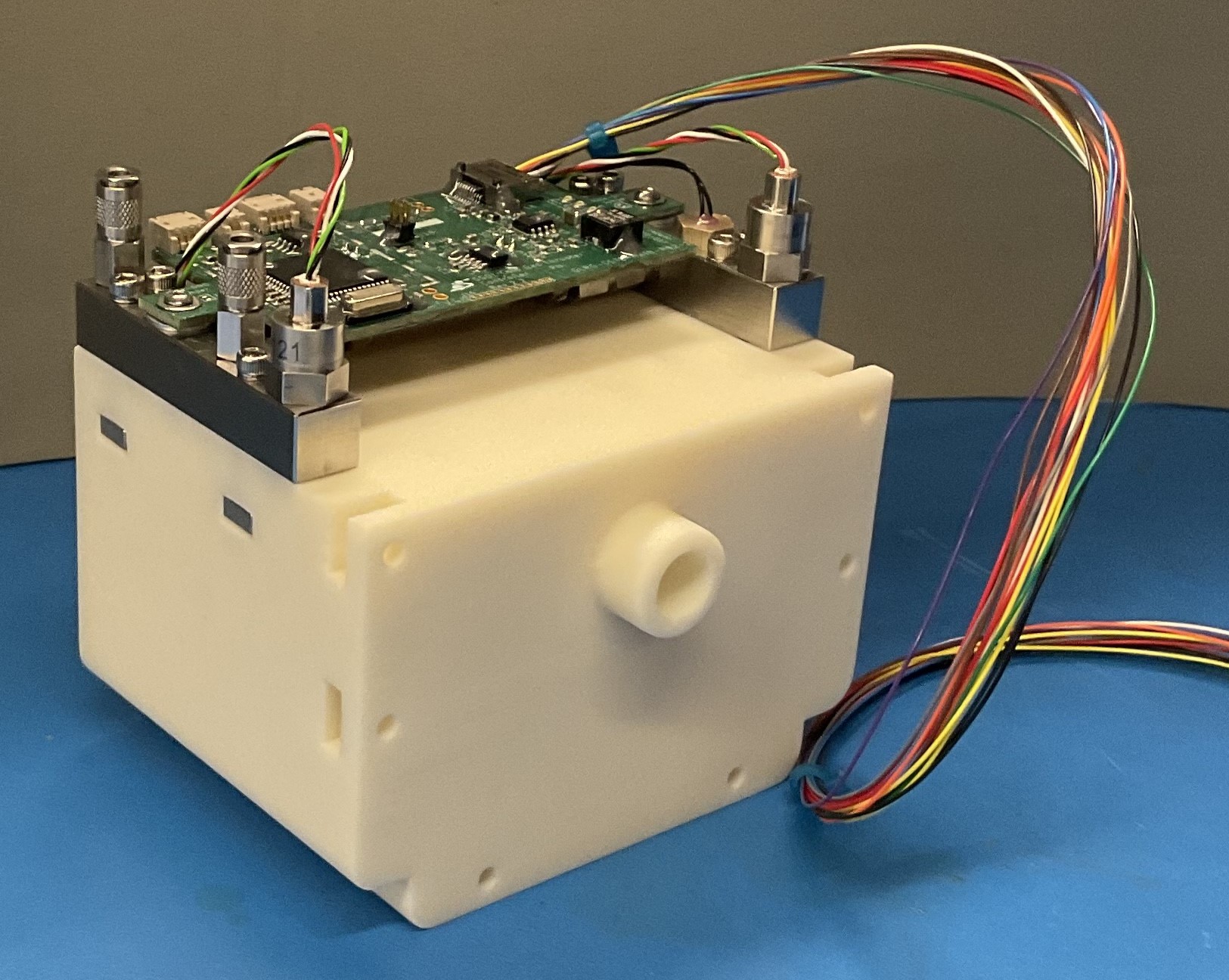
Example engineering development unit (EDU) of SWARM-EX that I helped assemble
Conference Papers:
- Hart, S. T., Daniel, N. L., Hartigan, M. C., & Lightsey, E. G. (2024). Design of the 3-D Printed Cold Gas Propulsion Systems for the VISORS Mission. In M. Sandnas & D. B. Spencer (Eds.), Proceedings of the 44th Annual American Astronautical Society Guidance, Navigation, and Control Conference, 2022 (Vol. 179, pp. 845–855). Springer International Publishing. https://doi.org/10.1007/978-3-031-51928-4_48
- Tong, K., Hart, S., Glaser, M., Wood, S., Hartigan, M., & Lightsey, E. G. (2023). Design to Delivery of Additively Manufactured Propulsion Systems for the SWARM-EX Mission. Small Satellite Conference. https://doi.org/10.26077/04VP-RT97
Vestigo Aerospace LLC: Aerodynamically Stable DragSails for Spacecraft Deorbit
I worked for this company while at Purdue University during the summer of 2021. I primarily programmed the microcontroller to control drag sail deployment, timing, etc. (MSP430FR5969 if you’re curious). This is a device the end user can interface with over I2C, SPI, or UART to control various parameters pertinent to the drag sail. I concluded my summer by presenting my work in a Code Design Review to the company and an expert on the subject matter.
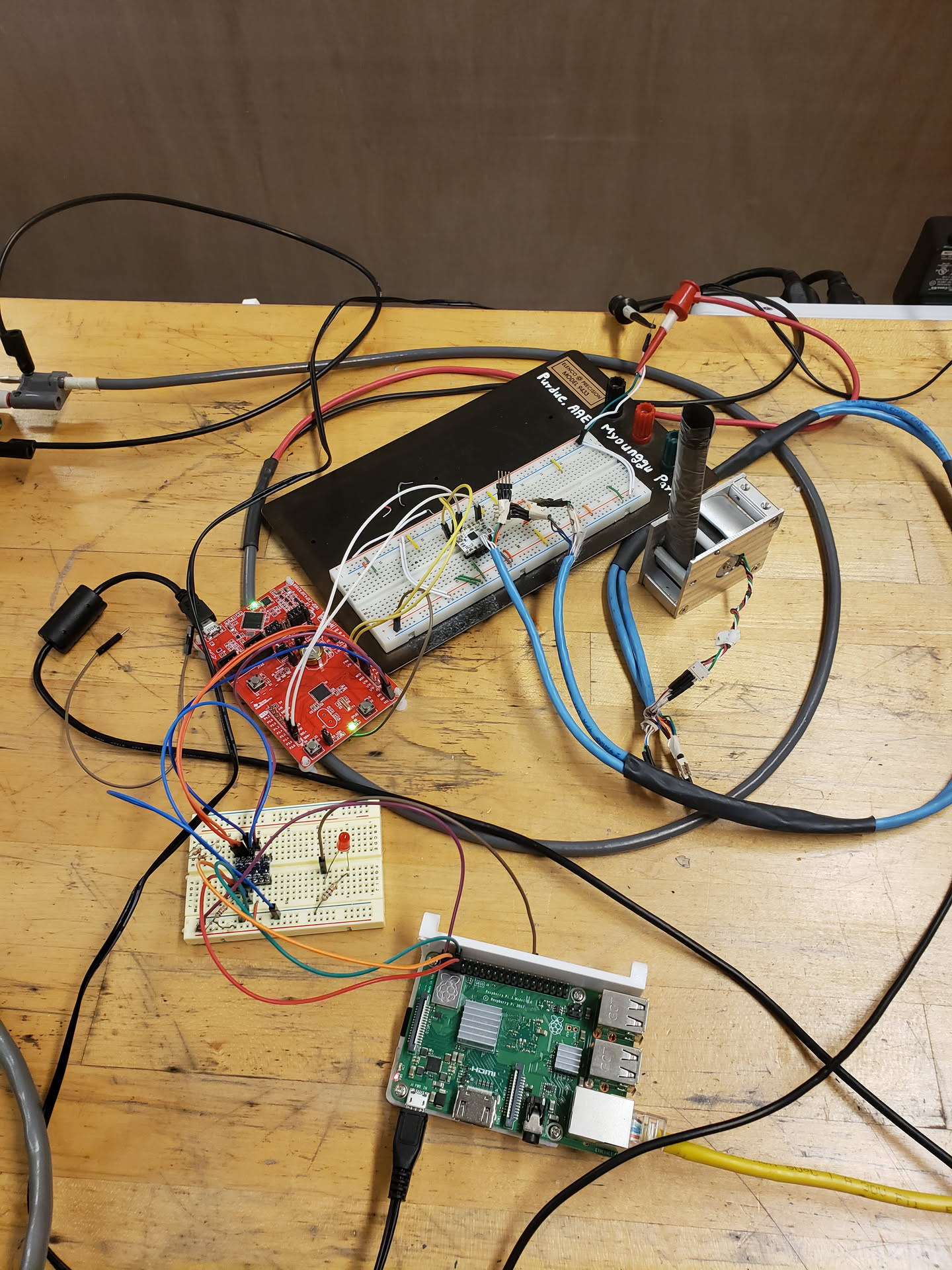
My flawless dev setup for testing boom deployment (feat. Raspberry Pi from my 3D printer)
Purdue University: FEMTA Suborbital Flight Experiment
I was project manager for Spring 2021 and was an undergraduate researcher here since Fall 2019! Our Github is publicly viewable.
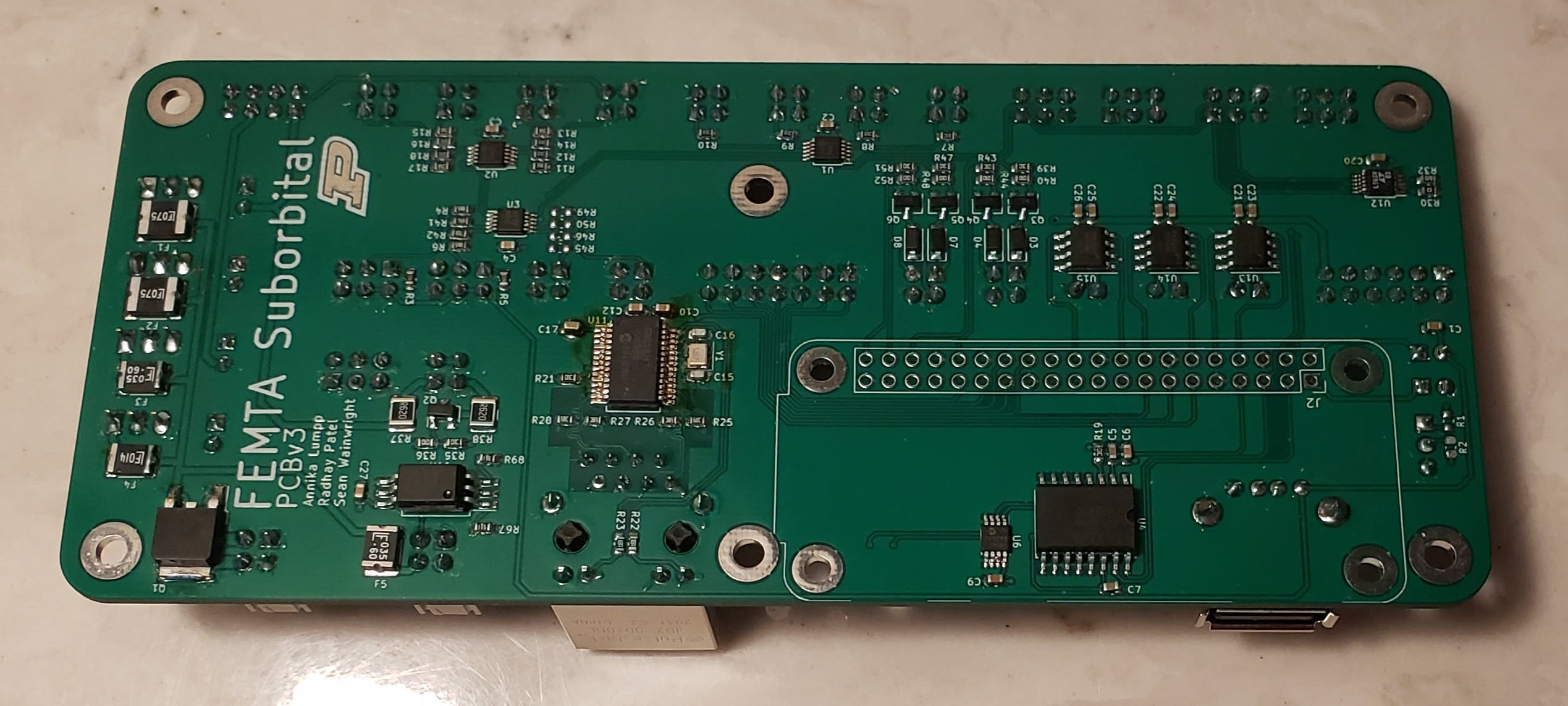
Project PCB I soldered together (didn’t design it but did tweak a couple things for mfr.)
Conference Presentations:
- Hartigan, M., Degener, M., (2021). “Using Plasma Spectroscopy to Measure Thrust of Micropropulsion Systems”. In Spring 2021 AAE Research Symposium Series. West Lafayette, IN.
- Lumpp, B., Ayhan, D., Deperna, J., Hartigan, M., Hawn, E., Johnson, A., Kinsella, J., Kracke-Bock, C., Patel, J., (2020). “Zero-Gravity Testing of a FEMTA Thruster Through Plasma Spectroscopy”. In Fall 2020 Purdue Undergraduate Research Conference. West Lafayette, IN.
- Lumpp, B., Chow, J., Deperna, J., Hartigan, M., Johnson, A., Kinsella, J., (2020). “Developing a Numerical Model of the FEMTA Propellant Management Experiment”. In Fall 2020 Purdue Undergraduate Research Conference. West Lafayette, IN.
- Lumpp, B., Cavanaugh, B., Degener, M., Deperna, J., Govindhan, A., Hartigan, M., Menon, A., Park, J., Patel, J., (2020). “Optimizing, Testing, and Manufacturing the FEMTA Propellant Management System Design”. In Fall 2020 Purdue Undergraduate Research Conference. West Lafayette, IN.
- Chow, J., Czech, C., Degener, M., Franks, .N, Govindhan, A., Hartigan, M., Kiddy, S., Kracke-Bock, C., Lumpp, A., Lumpp, B., Menon, A., Patel, R., Shahin, T., Soberg, J., Yu, Y., (2020). “Suborbital Testing of a Small Satellite Propulsion System”. In Spring 2020 Purdue Undergraduate Research Conference. West Lafayette, IN.